Mastering the Aquascape: A Beginner’s Guide to Living Underwater Art
Aquascaping is the art of designing and arranging aquatic plants, rocks, driftwood, and substrate inside an aquarium to create a natural underwater landscape. For many enthusiasts, mastering the aquascape is the perfect blend of artistic creativity and ecological science.
A successful aquascape is not simply about placing plants inside a tank. It requires understanding design principles, biological balance, lighting, substrate, and long-term aquarium maintenance. When all these elements work together, the result is a thriving underwater ecosystem that resembles nature itself.
This guide explains everything beginners need to know about Mastering the aquascape, from choosing the right aquarium size to understanding the nitrogen cycle and maintaining a healthy planted aquarium.
Understanding Aquascaping
Aquascaping can be compared to underwater landscape design. Instead of soil, trees, and rocks found in terrestrial gardens, aquascapes use:
Aquatic plants
Driftwood
Natural rocks
Specialised aquarium substrates
Carefully selected fish and aquatic life
The goal is to recreate natural environments such as rivers, forests, valleys, or mountains beneath the water surface.
Popular aquascaping styles include:
Nature Style
Inspired by natural landscapes such as forests or hills.
Iwagumi Style
Minimalist layouts built primarily around stones.
Dutch Style
Focused heavily on plant variety and colour contrast.
Regardless of the style, Mastering the aquascape requires balancing artistic design with biological stability.
Choosing the Right Aquarium Size
One of the most important decisions when starting an aquascape is selecting the correct tank size.
Beginners often assume smaller aquariums are easier to maintain. In reality, the opposite is true.
The Ideal “Goldilocks” Tank Size
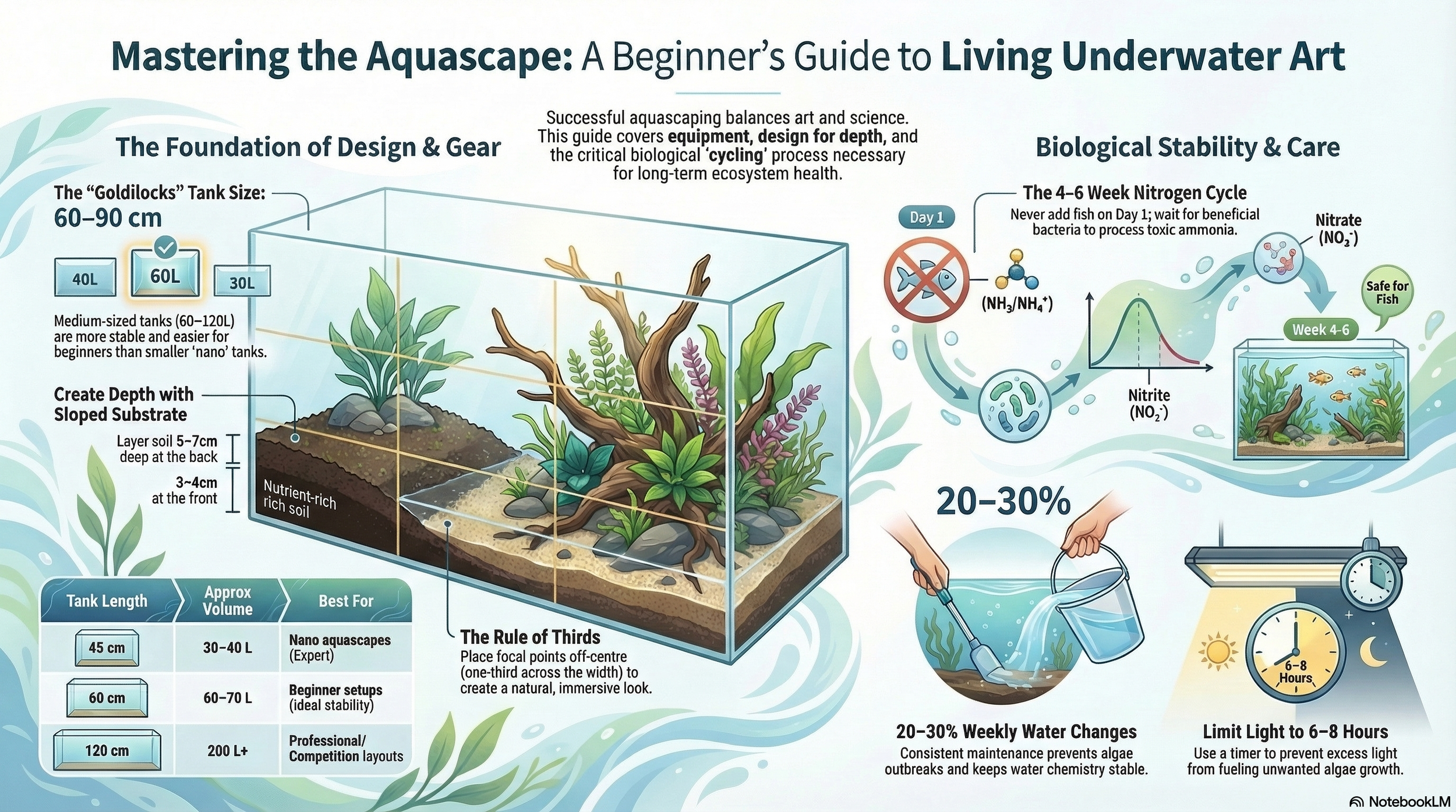
For most beginners learning Mastering the aquascape, tanks between 60 cm and 90 cm in length are ideal.
Typical aquarium sizes include:
45 cm (30–40 litres) - Nano aquascapes
60 cm (60–70 litres) - Ideal beginner setup
120 cm (200+ litres) - Professional layouts
Larger aquariums are easier to stabilise because water parameters change more slowly.
Designing the Aquascape Layout
Aquascaping is heavily influenced by principles used in photography and landscape design.
The Rule of Thirds
One of the most powerful design tools when mastering the aquascape is the rule of thirds.
Instead of placing the main focal point in the centre, divide the tank into three sections horizontally and vertically. The primary focal point, such as driftwood or rocks, should sit roughly one-third across the tank.
This creates a more natural and visually pleasing composition.
Creating Depth
A well-designed aquascape should give the illusion of depth.
This is achieved by:
Placing larger plants and wood in the background
Using smaller plants in the foreground
Sloping the substrate from back to front
Hardscape Placement
The hardscape forms the skeleton of the aquascape.
Hardscape includes:
Driftwood
Stones
Rocks
Root structures
These elements determine the final layout and should always be arranged before adding plants.
Substrate: The Foundation of Aquascaping
The substrate is one of the most critical components when mastering the aquascape.
A proper substrate provides:
Nutrients for plant roots
Anchoring support for plants
Beneficial bacterial growth
Substrate Depth
A common method used by aquascapers is to create a slope.
Recommended depth:
Back of tank: 5–7 cm
Front of tank: 3–4 cm
This sloped design enhances visual depth and improves water circulation through the substrate.
Nutrient-Rich Soil
High-quality aquascaping soil contains nutrients essential for plant growth, including:
Iron
Potassium
Trace minerals
This allows plants to establish strong root systems and maintain healthy growth.
The Nitrogen Cycle: The Science Behind Stability
While aquascaping may look artistic, its success depends heavily on biological balance.
Before adding fish, the aquarium must undergo the nitrogen cycle.
What Happens During Cycling
Organic waste in the aquarium produces ammonia, which is toxic to fish.
Beneficial bacteria convert this in stages:
Ammonia (NH3) forms from waste.
Bacteria convert ammonia into nitrite (NO2).
Another bacterial colony converts nitrite into nitrate (NO3).
Nitrate is far less toxic and can be removed through water changes and plant absorption.
How Long Cycling Takes
A complete nitrogen cycle usually takes: 4–6 weeks
Fish should not be added until the cycle is fully established.
Lighting and Algae Control
Lighting plays a critical role when mastering the aquascape.
Plants require light to photosynthesise, but too much light can trigger algae growth.
Recommended Lighting Duration
For most aquascapes: 6–8 hours of light per day
Using a timer helps maintain consistency and prevents excessive algae development.
Signs of Too Much Light
Common algae problems include:
Green water
Hair algae
Brown diatoms
Balancing light, nutrients, and CO₂ is the key to preventing algae outbreaks.
Water Changes and Maintenance
Even a well-balanced aquascape requires regular maintenance.
One of the most important routines is performing water changes.
Weekly Water Change
Most aquascapers recommend: 20–30% water change every week
This helps:
Remove excess nutrients
Stabilise water chemistry
Prevent algae blooms
Fresh water replenishes minerals that plants require for healthy growth.
Choosing Plants for Aquascaping
Aquatic plants form the living structure of the aquascape.
Beginners should start with hardy species such as:
Foreground plants
Monte Carlo
Dwarf hairgrass
Midground plants
Anubias
Cryptocoryne
Background plants
Vallisneria
Rotala
Combining plants with different heights and leaf textures creates a more natural underwater landscape.
Fish and Livestock Selection
Fish should complement the aquascape rather than dominate it.
Small schooling fish work best because they move gracefully through the layout.
Popular aquascaping fish include:
Neon tetras
Ember tetras
Rasboras
Otocinclus
Shrimp such as Amano shrimp are also helpful because they naturally control algae.
The Balance Between Art and Ecology
What truly defines mastering the aquascape is the ability to combine creativity with ecological knowledge.
An aquascaper must think like both an artist and a biologist.
Successful aquascapes:
Look natural and balanced
Maintain stable water chemistry
Support healthy aquatic life
With time and experience, aquascaping becomes a deeply rewarding hobby that evolves into a living work of art.
Final Thoughts
Mastering the aquascape takes patience, observation, and careful planning. By choosing the right tank size, building a strong substrate foundation, designing with the rule of thirds, and allowing the aquarium to complete its nitrogen cycle, beginners can create stunning planted aquariums that thrive for years.
Aquascaping is more than decorating an aquarium. It is the process of creating a miniature ecosystem where plants, water, and life exist in perfect balance.
For anyone fascinated by nature, design, and aquatic life, mastering the aquascape opens the door to an endlessly creative underwater world.
